When to Go to Komodo for Calm Seas and Visibility
The dry season, broadly April through November, offers the calmest seas and the most reliable underwater visibility for a Komodo National Park trip, while the wet season (roughly December-March) brings a higher chance of rough water, squalls and reduced visibility for snorkeling and diving.
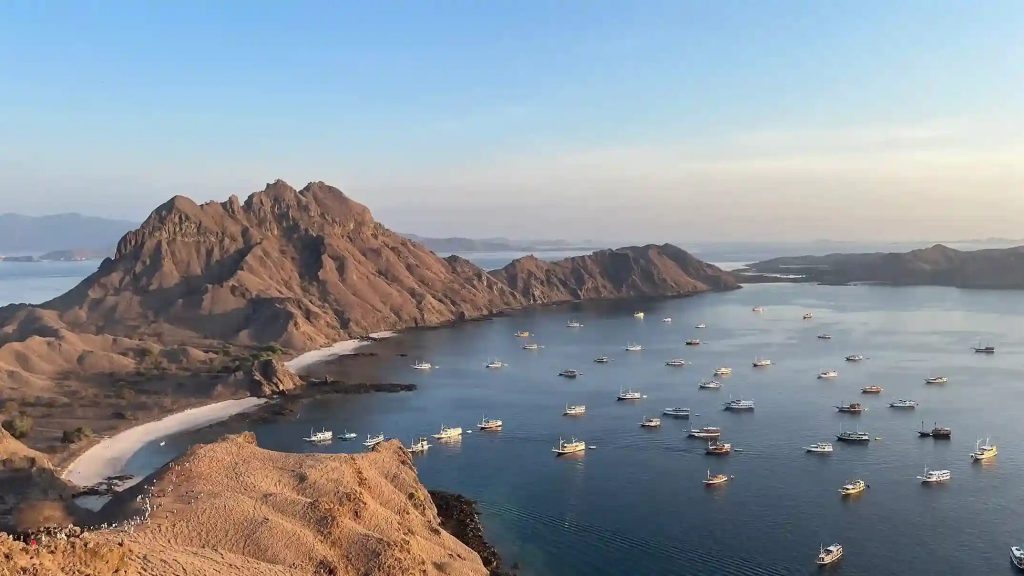
Within the dry season, conditions still vary month to month with plankton blooms, currents and wind — this page breaks down what actually changes and why, rather than treating “dry season” as one uniform block of ideal weather.
This page is about sea state and visibility: which months give the calmest crossings and the clearest water, and why calm weather and clear water are not the same variable. If you want the month-by-month table of temperature, rainfall and crowding instead, that lives on the best-time-to-visit page; if your trip is being built around manta sightings specifically, the manta season page works through that window on its own terms.
Why sea conditions and underwater visibility don’t move together
Calm surface conditions and clear underwater visibility are related but not identical — a flat, glassy sea can still have reduced visibility if plankton levels are high, since plankton blooms (which draw manta rays to feed and are part of why Komodo’s marine life is so rich) also reduce how far you can see underwater. Conversely, a slightly choppier surface doesn’t necessarily mean poor visibility below it. Divers and photographers planning around visibility specifically should treat sea state and visibility as two separate questions rather than assuming one guarantees the other.
Dry season vs. wet season: the practical difference
| Dry season (≈April-November) | Wet season (≈December-March) | |
|---|---|---|
| Sea conditions | Generally calmer, more predictable crossings | Higher chance of squalls and rougher water |
| Booking demand | Peak months (roughly June-September, December-January holidays) book out furthest ahead | Lower demand, more last-minute availability |
| Schedule reliability | Lower risk of weather-driven delay | Higher chance a captain reroutes or delays for safety |
These are general seasonal tendencies rather than guarantees — any given day within either season can defy the pattern, which is why experienced operators make real-time calls based on the actual forecast rather than the calendar alone.
What affects underwater visibility specifically
Visibility at Komodo’s dive and snorkel sites is shaped by a combination of current strength, plankton density and recent rainfall run-off from nearby land. Manta ray cleaning stations like Manta Point often see reduced visibility precisely when plankton is most abundant — the same conditions that draw the mantas in to feed. This trade-off is worth knowing if photography-quality visibility matters more to you than manta encounters, or vice versa; ask your operator which recent trips have reported which conditions, since day-to-day variation can be significant even within the same week.
Best months for calm crossings and reliable weather
The core dry-season months, roughly June to September, are generally regarded as offering the most consistently calm sea conditions for boat crossings between islands, alongside the lowest chance of a rain-driven schedule disruption. This overlaps with peak tourist season, so calmer weather comes with more competition for boat availability and SiOra session slots — booking well ahead matters more in this window than any other time of year.
The reservation system is run by the park rather than by any operator, which is why every itinerary funnels through the same portal, and reservations are made at siora.id.
Shoulder months: a practical trade-off
The months bordering the wet season — roughly late March/April and November/December — can offer a middle ground: fewer crowds and more schedule flexibility than peak season, with a moderate, manageable risk of a weather-affected day rather than the more frequent disruption typical of the core wet-season months. Travelers with flexible itineraries and a tolerance for the occasional adjusted schedule often find this window a reasonable compromise.
How this affects diving vs. snorkeling vs. trekking plans
Trekking on Komodo, Rinca or Padar is far less weather-sensitive than water-based activities — rain affects trail comfort but rarely cancels a trek outright. Snorkeling and diving are more exposed to both sea-state and visibility swings, which is why a trip built specifically around underwater photography or diving benefits more from targeting the calmer core dry-season window than a trip focused mainly on dragon trekking. See our snorkeling guide for site-specific detail on Manta Point and Pink Beach conditions.
Month-by-month, in general terms
Rather than assigning an exact number to each month without a verifiable source, the reliable pattern to plan around is this: December through March carries the highest chance of rain and rough seas; April sits in a transitional zone with generally improving conditions as the dry season begins; June to September is the most consistently calm and clear window and also the busiest; October and November form the tail end of the dry season, still generally settled but gradually building toward the wet-season pattern that takes over in December. Treat any source quoting precise visibility-in-meters figures per month with some caution unless it cites a specific dive operator’s logged data with dates, since underwater visibility genuinely varies day to day even within a favorable month.
Planning your trip timing
If your dates are flexible, weighting toward the May-September window improves your odds of both calm crossings and clear visibility, at the cost of booking further ahead and paying peak-season demand. Komodo Luxury can advise on current conditions closer to your travel date; message the team on WhatsApp at +62 811-3810-8110.
How operators actually make day-to-day weather calls
Experienced Komodo boat crews check real-time marine forecasts each morning rather than relying purely on seasonal averages, and a good operator will proactively suggest a schedule adjustment — a different route order, a delayed departure, or in rare cases a rescheduled day — rather than pushing ahead into genuinely unsafe conditions. If your captain suggests a change on the day, treat it as a safety-informed judgment call from someone reading the actual conditions, not an inconvenience to push back against.
More posts
Frequently asked questions
When is the best time to visit Komodo National Park for calm seas?
Broadly the dry season, April through November, with the core months of June to September generally offering the most consistently calm crossings.
Does calm weather mean good underwater visibility?
Not always — plankton blooms can reduce visibility even on a calm-surface day, and those same blooms are part of why manta rays are drawn to sites like Manta Point.
What is the wettest, roughest time to visit?
Roughly December through March, when squalls and rougher seas are more likely to affect boat schedules.
Is trekking affected by the wet season?
Less than water-based activities — rain affects trail comfort but rarely cancels a dragon trek outright.
Last updated: August 2026.
Which month has the clearest visibility in Komodo for diving?
August typically offers some of the clearest underwater visibility in Komodo National Park, making it ideal for diving. During this time, the dry season is in full swing, reducing plankton blooms and enhancing visibility. However, conditions can vary, so divers should also consider real-time forecasts.
What is the underwater visibility like in Komodo National Park?
Underwater visibility in Komodo National Park varies with the seasons. The dry season, from April to November, generally provides clearer waters, especially in the peak months of August and September. Plankton blooms, while attracting marine life, can occasionally reduce visibility, so conditions can fluctuate.
Are Komodo National Park speedboats rough in September seas?
In September, seas around Komodo National Park are generally calm, making speedboat journeys smoother compared to the wet season. However, occasional winds can create choppy conditions. It’s advisable to check forecasts and choose experienced operators who can adjust routes for comfort and safety.
How is the visibility for snorkeling in Komodo National Park in August?
Snorkeling visibility in Komodo National Park in August is typically excellent, as this month falls within the dry season. Reduced plankton levels contribute to clearer waters, enhancing the snorkeling experience. Visitors should still check local conditions, as visibility can vary with currents and weather.
Is Pink Beach in Komodo National Park affected by earthquakes?
Pink Beach, like the rest of Komodo National Park, can be affected by seismic activity due to Indonesia’s location on the Pacific Ring of Fire. While earthquakes are possible, they are not frequent, and the park has measures in place to ensure visitor safety during such events.
How does the diving visibility in Komodo compare to the Similan Islands?
Diving visibility in Komodo National Park is generally excellent during the dry season, comparable to the Similan Islands. Both locations offer rich marine biodiversity, but Komodo’s visibility can be affected by plankton blooms, which also attract diverse marine life. Conditions in both areas can vary seasonally.
December, as the wet season sets in
December opens the wet season, which on this coast runs through to March. Rain arrives in short heavy bursts rather than all day, but the sea state is what changes the trip: crossings get lumpier, and an afternoon squall can cut a stop short or move it.
It is not a closed month. Day trips keep running, temperatures stay warm, and the hillsides turn green in a way they never do in August. December also sits inside the strongest manta window and near the start of the largest aggregations at Manta Point — plankton-rich water that brings the animals in and takes the visibility down at the same time.
August, the driest and the busiest
August sits in the calm core of the dry season, roughly June to September, and it is about as settled as the park gets: flat crossings, firm trekking ground, dependable flight schedules and clear water.
It is also the busiest month of the year alongside July, and that is the part worth planning around rather than the weather. SiOra session slots, the better boats and the Padar viewpoint at first light all get contested in August. If the trip is fixed to that month, book earlier than you otherwise would; if it is flexible, June or September buy nearly the same conditions with noticeably fewer people.
How the tariff falls on Indonesian visitors
Indonesian citizens pay USD 20 on a regular day and USD 25 at weekends and on public holidays, the same two-tier shape as the foreign-visitor rate of USD 40 and USD 50.
The practical effect is a mild push towards weekday visits, which is presumably the intent: it spreads domestic demand away from the Saturday and holiday peaks that already compete hardest for SiOra session slots. The ranger escort is inside the entrance rate for every visitor, so an Indonesian citizen pays USD 20 on a regular day and USD 25 at a weekend or on a public holiday, with nothing further at the post.
What to wear for a trekking and boat day
There is no formal dress code, but the day asks two different things of you. On the trails: light long-sleeved cotton or a technical shirt, a hat, and closed shoes with grip — the ground is loose rock and dry grass, and sandals are the most common regret. On the water: swimwear under the clothes, because the gap between stepping off the trail and getting in at Pink Beach is often minutes.
Two practical notes. Reef-safe sunscreen and a long-sleeved rash vest do more than repeated applications of anything else, since there is almost no shade on deck. And leave anything you mind ruining behind — salt, dust and dragged bags do the rest.
What genuinely low-impact operating looks like
The label is unregulated, so it is worth knowing which behaviours actually distinguish an operator. Mooring at fixed buoys rather than dropping anchor onto coral is the biggest single one. After that: refill water rather than cases of bottles, no feeding or baiting of any animal, keeping the boat’s distance at Manta Point instead of dropping snorkellers on top of a passing ray, and carrying all waste back to Labuan Bajo rather than burning it on board.
Crew is the other half of it. Locally crewed boats paying local wages keep the money in Flores, and a briefing that explains why you stay behind the ranger is a better signal than any certificate on a website.
The park in brief
Komodo National Park covers roughly 1,733 km² of islands and sea in East Nusa Tenggara and has been a UNESCO World Heritage Site since 1991. Its three main islands are Komodo, Rinca and Padar, with Labuan Bajo on Flores as the gateway.
The park’s own annual counts put the dragon population at roughly 3,150–3,400 animals of all ages — a figure that should not be confused with the IUCN’s 1,383, which counts mature breeding adults worldwide. Visitor numbers are capped at 1,000 per day across the whole park, split across three sessions, and since 1 April 2026 entry to Komodo and Padar has required an advance SiOra e-ticket.
Start Planning Your Komodo Trip
Tell Komodo Luxury your travel dates, group size and priorities — trekking, diving, a private charter or a budget-friendly shared boat — and they will put together options with current pricing.