
Taka Makassar: The Tidal Sandbar Next to Manta Point
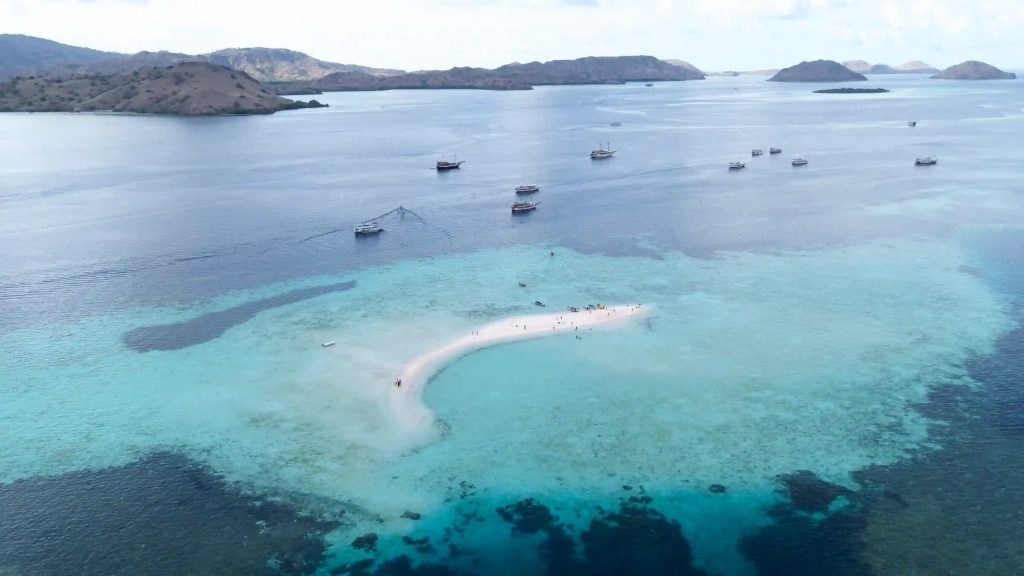
Taka Makassar is a sandbar, not an island. It is a low crescent of white sand with a pink cast in places, lying in shallow water east of Komodo Island, and it changes size and shape with the tide — at high water much of it disappears entirely. Boats stop there for twenty minutes to an hour, usually straight after the manta drift at nearby Karang Makassar, because the two sit within a few minutes of each other.
What you are actually looking at
The Indonesian word taka means a reef flat or shoal, and that is the honest description: a bank of coral rubble and shell fragment that the current has piled into a curve above sea level. The pink tint in the sand comes from the same source as the colour at Pink Beach — fragments of red organ-pipe coral ground fine and mixed through white carbonate sand — though it is subtler here and shows best when wet.
Because the whole feature is built by water, it is not fixed. The crescent points a different way in different seasons, and the walkable area at low tide can be several times what it is at high. Photographs taken from a drone at low water are what set expectations; the reality at 11am on a spring high tide can be a thin ribbon with people standing ankle-deep.
Snorkelling off the sandbar
The reef on the sheltered side shelves gently and holds hard coral, small reef fish and, often, turtles moving between the seagrass patches. It is one of the easier entries in the park: you walk in from the sand rather than giant-striding off a boat, and the depth stays friendly for anyone who is not a confident swimmer.
The exposed side is a different proposition. The same current that built the bar runs past it, and it can move a snorkeller a long way in a short time. Guides normally point out which end of the crescent is safe on the day, and that assessment changes with the tide rather than with the season, so it is worth asking rather than assuming yesterday’s answer holds.
How it combines with Manta Point
Almost nobody visits Taka Makassar on its own. The standard sequence is a drift at Manta Point — the cleaning station at Karang Makassar — followed by the sandbar as a rinse-off and photo stop, because the boat is already there. On a three-day route the pair usually lands on the second or third morning; on a one-day speedboat itinerary they are the reward for an early departure, and our snorkelling guide sets out how the stops usually chain together.
There is no landing fee specific to the sandbar and no ranger station on it. Your park entrance ticket covers the visit, and the advance e-ticket requirement that came in for Komodo and Padar in April 2026 does not attach to a sandbar stop — though most itineraries that reach Taka Makassar include a Komodo landing somewhere, which does need it.
A foreign visitor pays USD 40 per park entry on a regular day and USD 50 at weekends and on public holidays, with the licensed ranger paid for inside that rate, and the published regulation is at peraturan.go.id.
Practical notes that matter more than they sound
There is no shade. None — not a tree, not a rock, not a structure. The sand reflects light upward as well as down, which is why people who were fine all morning burn here in half an hour. A rash guard does more good than sunscreen, and reef-safe sunscreen does more good than the alternative on a bar this shallow.
There is also no bin, no toilet and no fresh water. Everything that comes ashore has to leave with you, and on a feature this small a dropped bottle cap is visible for the rest of the day. Standing on live coral at the edge of the sand is the other common damage; the walkable zone is the loose rubble, not the reef shelf beyond it.
Because the sandbar is always paired with the manta drift next door, the stop you actually book is the boat day around it. Komodo Luxury’s Komodo boat tour options set out which day and overnight formats include the Karang Makassar area and how much water time each one leaves for it. Questions about a specific date go to WhatsApp +62 811-3810-8110 or sales@komodoluxury.com.
More posts
Frequently asked questions
Is Taka Makassar always above water?
No. It is a tidal feature, and at high water most of the crescent is submerged, leaving a shallow shelf you stand on rather than a beach you walk along. Operators time the stop around the tide where they can, which is one reason the order of stops on a day trip is not fixed in advance.
Why is the sand pink here?
Fragments of red organ-pipe coral, broken down and mixed with white carbonate sand, give the same effect that makes Pink Beach famous a short distance away. The colour is more obvious when the sand is wet and in low-angle light, and it photographs stronger than it looks to the eye.
Can you see manta rays from the sandbar?
Occasionally, but that is luck rather than a plan. The mantas gather at the cleaning station a few minutes away, and the sandbar stop is what happens after the drift rather than a second chance at it. If mantas are the priority, the number of passes your boat makes at Karang Makassar matters far more than time on the sand.
How long do boats usually stop?
Between twenty minutes and an hour, depending on the tide and how many boats are already there. It is a short stop by design: with no shade and nothing to walk to, most groups have taken their photographs and swum the sheltered side well inside that window.
Is it suitable for children?
Yes, with supervision, and it is one of the gentler stops in the park for a young family — shallow entry, no climb, no wildlife risk. The two things to watch are sun exposure, which is severe, and the drop-off at the exposed end, where the current runs harder than the calm surface suggests.
Start Planning Your Komodo Trip
Tell Komodo Luxury your travel dates, group size and priorities — trekking, diving, a private charter or a budget-friendly shared boat — and they will put together options with current pricing.