
Pink Beach Komodo: How to Visit and What to Expect
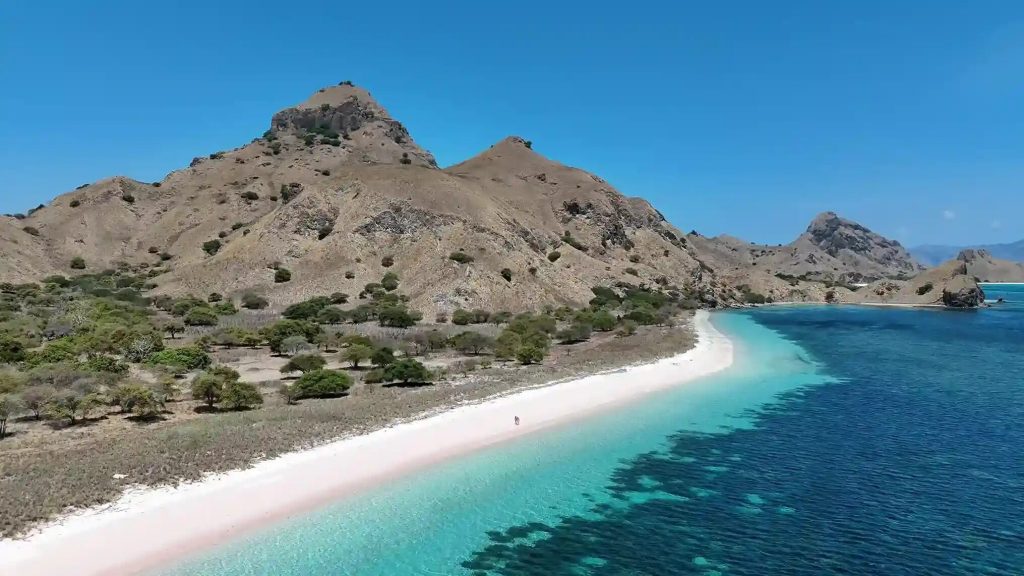
Pink Beach (Pantai Merah) on Komodo Island gets its color from red carbonate grains — mainly the shells of a tiny reef-dwelling organism called foraminifera, along with fragments of red organ-pipe coral — mixing with ordinary white coral sand.
Last updated: August 2026
It is one of a small number of naturally pink-sand beaches in the world, and one of the most photographed stops on any Komodo boat itinerary.
Why is the sand pink? The actual science
The pink tint comes from two natural sources mixing with white sand, not a single simple cause:
- Foraminifera, microscopic single-celled organisms with calcium-carbonate shells. A species commonly named in the research on pink-sand beaches, Homotrema rubrum, has a deep red shell and lives attached to coral rubble and reef ledges nearby. When these organisms die, waves grind their shells into fine red grains.
- Red organ-pipe coral (Tubipora musica), whose calcium-carbonate skeleton is naturally red; broken fragments wash ashore and mix into the same sand.
Sources differ on exactly how much each contributes to the final color — some describe foraminifera as the dominant source, others give organ-pipe coral fragments a larger role — but both are genuinely present and genuinely responsible for the pink hue, and this guide presents both rather than picking one to sound more precise than the science actually is.
Where exactly is Pink Beach?
The Pink Beach visited on standard Komodo boat tours sits on the southeastern coast of Komodo Island itself, inside Komodo National Park. Other spots in the wider park occasionally show a pinkish tinge on their sand, but this specific beach is the one included on the vast majority of published day-trip and liveaboard itineraries.
Is Komodo’s Pink Beach really that rare?
Pink-sand beaches are commonly described as one of only about seven found worldwide, alongside examples in the Bahamas, Bermuda, and a handful of other locations. That “seven” figure is a widely repeated popular estimate rather than a strict scientific census, so treat it as an indication of genuine rarity rather than an exact count — either way, a naturally pink beach is an unusual enough phenomenon that Komodo’s version is a legitimate highlight, not just a marketing label.
Snorkeling at Pink Beach: what to expect
| Factor | What to expect |
|---|---|
| Currents | Generally gentle to moderate close to shore, especially at slack tide; can strengthen further out or during tidal changes |
| Visibility | Often good, commonly in the 10–20+ meter range in the dry season |
| Reef | Shallow fringing reef starting close to shore, suitable for beginners; some areas show past trampling or anchoring impact |
| Marine life | Hard and soft corals, common Indo-Pacific reef fish (damselfish, parrotfish, wrasses), occasionally small reef sharks or rays in deeper water |
Conditions can shift with the tide, so follow your guide’s read of the water on the day rather than assuming it will match a general description like this one.
Rules at Pink Beach
The same park-wide conservation rules apply here as everywhere in Komodo National Park, with two that matter most at this specific site:
- Do not remove sand, shells, or coral fragments. This is both a conservation rule and, practically, the reason the beach stays pink — the colored grains are a limited, slow-replenishing resource.
- Do not stand on or damage living coral when entering or exiting the water; use the marked entry points your guide indicates.
Walking and swimming from the shoreline itself are entirely normal and permitted — the restriction is on removal and damage, not on visiting or enjoying the beach.
Best time to visit Pink Beach
Pink Beach is included on itineraries year-round, but the dry season (roughly April–November) offers calmer water and clearer visibility for snorkeling, with June through September typically the clearest window overall. See our full best-season planning page for the complete seasonal picture, including how conditions vary elsewhere in the park.
How to include Pink Beach in your itinerary
Pink Beach is a standard stop on nearly every multi-day Komodo itinerary and on most full-day speedboat trips, typically paired with a Komodo or Rinca dragon trek and a Manta Point snorkeling stop on the same day or the day before/after. It rarely needs to be booked as a separate add-on — confirm with your operator that it is included in your specific route rather than assuming, since a few tighter single-day itineraries prioritize other stops instead.
Photography tips specific to Pink Beach
The pink tint is most visible in direct sunlight and shows up more strongly in photos when the sand is dry rather than freshly wet from the tide — the wet-sand line right at the water’s edge often looks a deeper, more saturated pink than the dry upper beach, which is a useful framing trick rather than a sign of a “better” or “worse” section of sand. Midday sun, while less flattering for most beach photography, tends to render the color most accurately; early morning or late afternoon light is softer but can mute the pink slightly in comparison.
How Pink Beach fits into a wider Komodo day
Because Pink Beach is a snorkeling-and-relaxation stop rather than a full activity in itself, it typically occupies an hour to ninety minutes within a longer day that also includes a dragon trek and at least one other water stop. Travelers building their own priorities should think of it as a highlight within the day rather than a destination requiring a dedicated full-day booking on its own — nearly every standard itinerary already routes through it as part of a broader loop.
More posts
Frequently asked questions
Is the pink sand at Pink Beach real or a myth?
It is genuinely real. The pink tint comes from natural red carbonate grains — primarily foraminifera shells and red organ-pipe coral fragments — mixed with white coral sand, not dye, artificial coloring, or a trick of the light.
Can I take sand from Pink Beach as a souvenir?
No. Removing sand, shells, or coral fragments from Pink Beach is prohibited under Komodo National Park’s conservation rules, both to protect the ecosystem and to preserve the limited pink grains that give the beach its color.
Is Pink Beach good for non-swimmers?
Yes, to a point. You can walk along the shoreline and wade in shallow water without swimming at all; for snorkeling specifically, a life jacket is typically available for less confident swimmers, and the nearshore area is generally calmer than open water further out.
Is Pink Beach the same beach on Komodo and on Padar Island?
No. The famous Pink Beach included on standard tours is on Komodo Island’s southeastern coast. Padar Island is known for its viewpoint hike over three colored bays, not for a pink-sand beach of its own.
Pink Beach is included as a standard stop on Komodo Luxury’s Komodo boat tour and multi-day liveaboard itineraries — message +62 811-3810-8110 on WhatsApp to confirm it’s on your specific route.
To make your visit to Pink Beach a reality, explore the full fleet of options offered by Komodo Luxury. Before booking, it’s helpful to review their trip FAQ for detailed insights into what to expect.
How pink is the sand at Pink Beach Komodo really?
The sand at Pink Beach Komodo is distinctly pink due to the mix of red carbonate grains from foraminifera and fragments of red organ-pipe coral with the white coral sand. While the intensity of the pink hue can vary with lighting and weather conditions, it is consistently noticeable and one of the beach’s defining features.
How to visit Komodo National Park’s Pink Beach?
To visit Pink Beach, you must enter Komodo National Park, accessible via Labuan Bajo on Flores Island. Book a boat tour that includes a stop at Pink Beach, typically part of day-trip or liveaboard itineraries. Ensure you have a reservation through the SiOra e-ticket system due to visitor quotas.
Which island is better for photography: Padar or Komodo?
Padar Island is renowned for its panoramic views and unique landscapes, making it ideal for wide-angle photography. Komodo Island, with its Pink Beach and Komodo dragons, offers more diverse subjects. Both islands provide excellent photography opportunities, but Padar is often favoured for its dramatic scenery.
Are there non-swimming tours available in Komodo National Park?
Yes, non-swimming tours are available in Komodo National Park. These tours focus on trekking, wildlife observation, and visiting scenic spots like Pink Beach and Padar Island’s viewpoints. A mandatory ranger accompanies all treks, ensuring safety and providing insights into the park’s unique ecosystem.
What are the best beaches in Komodo National Park?
Pink Beach on Komodo Island is the most famous for its unique sand colour. Other notable beaches include those on Padar Island, known for their stunning views, and the beaches around Kanawa Island, which offer excellent snorkelling opportunities. Each beach provides a distinct experience within the park’s diverse landscape.
How does Komodo National Park preserve its natural beauty?
Komodo National Park preserves its natural beauty through strict visitor quotas, mandatory ranger-guided tours, and regulated entry fees that support conservation efforts. The park’s UNESCO status and government regulations help protect its unique ecosystems and wildlife, including the Komodo dragon population.
Start Planning Your Komodo Trip
Tell Komodo Luxury your travel dates, group size and priorities — trekking, diving, a private charter or a budget-friendly shared boat — and they will put together options with current pricing.