Kelor Island: The First Stop on Almost Every Komodo Day Trip
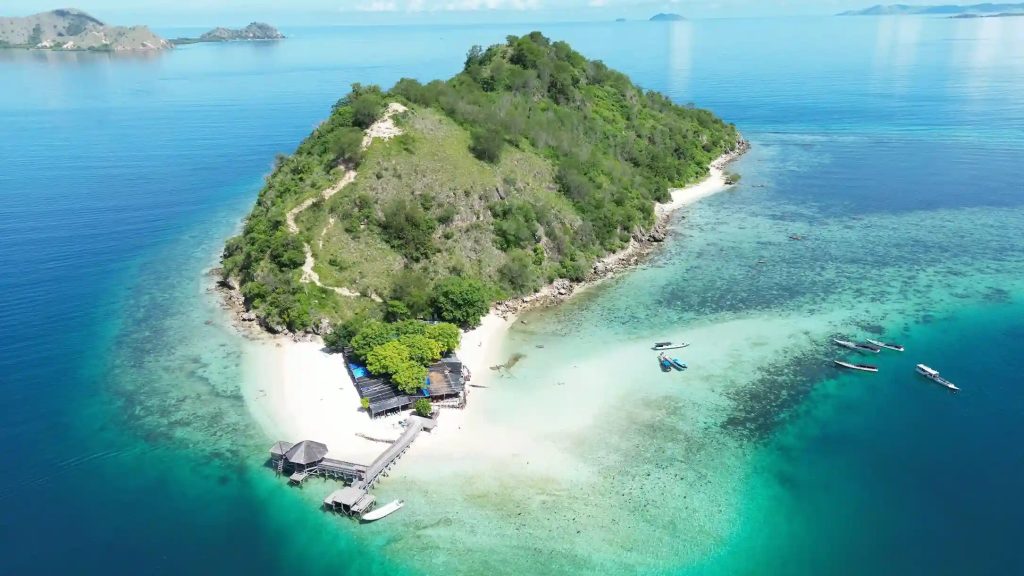
Kelor Island is the first stop on most Komodo day trips — a small, steep-sided island roughly half an hour by speedboat from Labuan Bajo, with a short beach on its sheltered side and a sharp grass hill behind it. It is where the boat pauses long enough for people to climb ten or fifteen minutes, take the view back over the harbour approaches, swim, and be on their way. Nobody comes to Flores for Kelor alone; almost everybody passes through it.
Where Kelor sits, and what that means
Kelor lies among the cluster of small islands between Labuan Bajo and the main body of the national park, in company with Bidadari, Sebayur and Kanawa. Being close to the harbour is exactly why it opens itineraries: it costs a boat almost nothing in daylight to stop there on the way out, and it gives passengers a first swim before the longer crossings start.
That proximity also sets expectations. The water here is calmer and shallower than the channels further in, the reef is modest rather than spectacular, and the hill is a warm-up rather than a challenge. Travellers who arrive expecting the park’s headline scenery on stop one are usually comparing Kelor against Padar’s sunrise ridge, which is a different scale of thing entirely.
The climb
The path goes almost straight up the spine of the island from the beach. It is short — ten to twenty minutes for most people — but the surface is loose dirt and dry grass on a steep gradient, and there is no shade and no rope. Going down is the part where people slip, so unhurried footing matters more than fitness.
From the top the view is back across the water toward the mainland and out over the scatter of islets, which is a quieter, greener panorama than the dramatic bays further into the park. Early departures get it without haze; boats arriving at midday get heat instead. If your group includes anyone who would rather not climb, the beach works perfectly well on its own, and our page on fitness, kids and seniors in the park covers which stops can be skipped without wrecking an itinerary.
Swimming and snorkelling
The sheltered bay has a sandy entry and a fringing reef within easy reach of the beach, with small reef fish and patchy coral. It is an easy, low-drama snorkel and a good place to find out whether a mask fits before the trip reaches water where that matters.
Currents run through the gaps between these islets and can be stronger than the flat surface implies, particularly around the points at either end of the beach. The safe swimming zone is the middle of the bay, and crews normally say so; treating that as advice rather than instruction is how people end up being collected by the tender.
How Kelor fits an itinerary
On a one-day trip it is stop one, followed by a dragon trek at Rinca or Komodo and one or two snorkel stops. On overnight and multi-day sailings it often becomes the last stop instead — a final swim on the run back into port while lunch is served. Either way it occupies half an hour to an hour, and no itinerary is built around it.
On permits, the picture is simpler here than deeper in the park: the advance e-ticket that has been mandatory since April 2026 attaches to landings on Komodo and Padar. Most day trips that call at Kelor go on to one of those islands, so the reservation still applies to the trip as a whole — which is why it is worth confirming your operator has filed it rather than assuming a beach stop means no paperwork.
Advance reservation through the park’s own system has been mandatory for Komodo and Padar since 1 April 2026 and is a park rule rather than an operator policy, and reservations are made at the SiOra booking portal.
When to go
The dry season, April to November, gives the calmest crossings and the firmest footing on the hill; the grass is greenest at the start of it and gold by October. In the wet season, December to March, the short crossing from Labuan Bajo is far less affected than the longer runs deeper into the park, so Kelor stays workable on days when a full-park itinerary would be uncomfortable. Rain also turns the path slick, which matters more on this gradient than the distance suggests.
Kelor is a stop rather than a destination, so what you are really choosing is the day trip it sits inside. Komodo Luxury’s Labuan Bajo tour options cover the short routes that open with Kelor and where they go afterwards. For a specific date or group size, reach the team on WhatsApp at +62 811-3810-8110 or by email at sales@komodoluxury.com.
More posts
Frequently asked questions
How far is Kelor Island from Labuan Bajo?
Roughly half an hour by speedboat in normal conditions, and appreciably longer on a traditional wooden boat, which is why slower vessels sometimes drop it in favour of protecting the day’s later stops. It is the closest of the standard day-trip islands to the harbour.
How hard is the Kelor Island hike?
Short but steep. Ten to twenty minutes up a loose dirt and grass path with no steps, no rope and no shade, and a descent that most people find slower than the climb. It suits anyone comfortable on uneven ground; it does not suit flip-flops.
Is Kelor Island inside Komodo National Park?
Kelor sits in the belt of small islands between Labuan Bajo and the park’s main islands, and it is grouped with the outer islets rather than with Komodo, Rinca and Padar. Your operator handles the fee position for the route as a whole; the entrance ticket you pay is for the park itself, not for a beach landing.
Can you snorkel at Kelor?
Yes, straight off the beach in the sheltered bay, over a shallow fringing reef with small fish. It is a gentle site rather than a memorable one, and its real value is as the shakedown snorkel before the trip reaches Manta Point or Pink Beach.
Is there anything on the island?
No shop, no toilet, no fresh water and no shade beyond what you carry. Boats provide everything, and whatever is brought ashore leaves again — the beach is small enough that litter is conspicuous and slow to disappear.
Start Planning Your Komodo Trip
Tell Komodo Luxury your travel dates, group size and priorities — trekking, diving, a private charter or a budget-friendly shared boat — and they will put together options with current pricing.